

Open X for a minute and imagine you are one of your future clients. They may see a mortgage-rate argument, a clip from city council, a neighborhood restaurant opening, a complaint about traffic, and a listing they cannot afford.
Somewhere in that mix, they are trying to answer a real question: Should we move now? Can we handle the payment? Is this neighborhood changing? What would our home actually sell for?
Most agents respond by posting another listing flyer. The flyer disappears because it asks for attention before earning any trust. The agents who keep showing up in local feeds explain the place, answer the question behind the question, and share details that only someone doing the work would notice.
X recently opened more of the code behind its “For You” feed. I, together with my AI agent, read through the release looking for practical lessons a real estate agent could use.
You can ignore the engineering vocabulary. The useful part comes down to a simple idea: X tries to show each person posts they are likely to care about, spend time with, share, reply to, or follow back to the source.
Below is everthing you need to do to dominte your clients’ timelines.
Win a corner of the market, not the whole internet
“Real estate” is too broad. Even “Orange County real estate” may be too broad for a person deciding whether to sell a condo in Irvine or buy a larger home near a particular school.
Picture one reader before you write. Maybe she owns a two-bedroom condo and wonders whether she can move up without doubling her monthly cost. Maybe he inherited a house that needs work and has no idea which repairs will matter. Maybe a family relocating from another state is comparing commute times, school boundaries, insurance costs, and the feel of three neighborhoods.
Now write for that person. A generic post says, “Inventory is rising. Contact me for details.” A useful local post says, “Eleven detached homes are for sale in Northwood today. Six have been sitting for more than 30 days, which gives move-up buyers more room to negotiate than they had this spring.”
The second post names a place, shows the evidence, and explains why it matters. A homeowner can recognize herself in it. A spouse can forward it. A stranger can visit your profile and immediately understand what you know.
Choose a local beat you can cover for a year. For example:
Irvine move-up homes and the monthly-cost decisions owners face
older homes in a specific city and the inspection problems buyers miss
condos in two or three neighborhoods, with honest coverage of HOA costs and documents
relocation into your market, including commute and neighborhood tradeoffs
downsizing for longtime owners who need to sell before they buy
A narrow beat does not shrink your business. It gives people a reason to remember you.
Turn today’s work into tomorrow’s post
Agents often say they have nothing to post. Then they spend the day answering five client questions, touring four homes, reading an inspection report, and noticing a price reduction that changes the competition for a listing. Their workday has already supplied the content.
At the end of each workday, write down three things:
What question did a client ask more than once?
What surprised you in a showing, inspection, negotiation, or MLS search?
What local detail could change someone’s decision?
Pick one and explain it in plain English. Remove names, addresses, confidential facts, and anything your client has not given you permission to share.
A buyer asks why two similar homes sold for very different prices. You can explain the differences without identifying the buyer.
An inspector finds a costly problem that looked harmless in listing photos. With permission, you can show what buyers should look for.
A city meeting changes the timing of a development. You can translate what that may mean for nearby owners instead of reposting a government link with no context.
Ten open-house visitors ask the same question about the property. Answer it publicly. One good explanation can keep working long after the open house ends.
Your daily work gives you an advantage over national accounts and generic content services. They can repeat a housing headline. They cannot stand in the kitchen you toured this morning and explain why buyers loved the house online but hesitated in person.
Write posts people would actually send to someone
X pays attention to many kinds of response. My AI agent read the entire code and created this cheat sheet so you don’t have to:
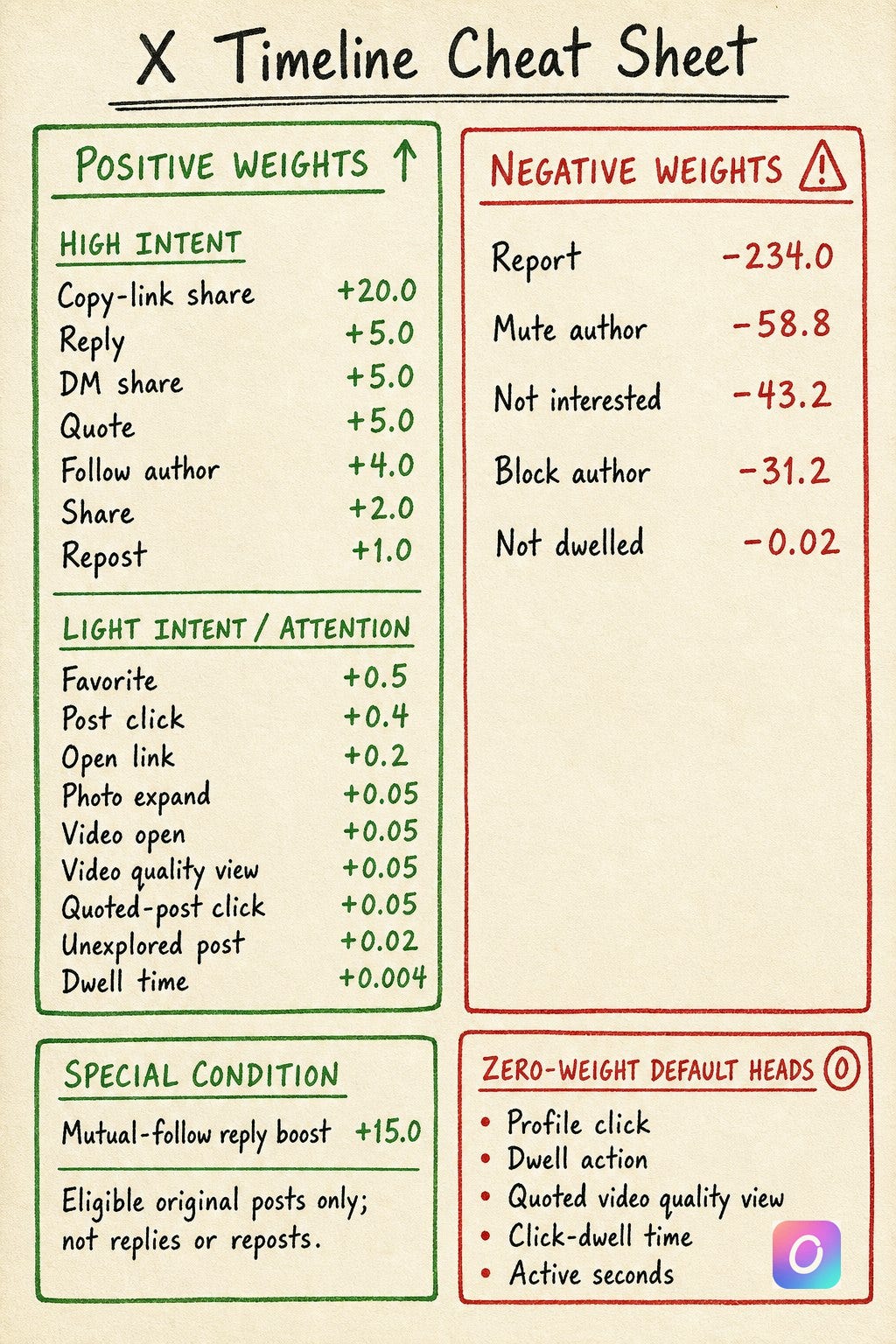
Don’t worry, you do not need to memorize every scoring rule on this chart. Ask a more useful question before publishing:
Would a local person send this to a spouse, neighbor, buyer, seller, or friend?
Forwardable real estate posts usually help with a decision. A few examples:
a simple comparison of monthly costs for two realistic purchase options
a short checklist for reviewing condo documents
one photo from an inspection with an explanation of the risk
a map that explains a commute, boundary, development, or insurance issue
a candid tradeoff between two homes or two neighborhoods
Give the useful part inside the post. Share enough knowledge to prove you can help. The right person can still message you when the explanation reaches a problem they are trying to solve.
Questions can work when the answers are genuinely interesting. “Agree?” adds very little. A question such as “Would you choose the smaller Tustin home with a 12-minute commute or the extra bedroom in Mission Viejo with 35 minutes on the freeway?” gives people a real tradeoff to discuss.
A good local post should feel like something you would say across a kitchen table, only clearer.
Give each listing more than one story
Agents often repeat the same listing message with a different graphic:
Just listed. Open house. Price improvement. Still available.
The reader sees one idea four times. X also tries to avoid filling a feed with repetitive material from the same account.
Keep talking about the property, but change the value of each post. One can explain how you arrived at the price. Another can show the room buyers misunderstood in the photos. A third can walk through the five minutes around the block. After the open house, answer the question visitors asked most often. If the price changes, explain what the new price means relative to nearby competition.
The same principle applies to market updates. If Tuesday’s post says inventory rose, Wednesday’s post needs to explore the consequence. Which neighborhood changed most? Which price range gained choices? What should a seller do differently?
Variety does not require constant invention. It requires looking at the same market from the different decisions your clients have to make.
Small local accounts have a useful advantage
A national housing account can publish faster and reach more people. It cannot know your streets the way you do.
The public code includes ways for newer or less-seen accounts to get a chance in the feed. A post has to be relevant to the viewer and good enough to hold attention. Yet follower count alone does not close the door.
Specificity gives a small account a fighting chance. “Home prices are changing” could come from anyone. “Why two Woodbridge homes with the same square footage closed $87,000 apart” contains a place, a puzzle, and a reason to keep reading. If you can support the comparison with accurate public information and explain the difference fairly, you have a post that a local homeowner may care about even if she has never heard your name.
Your goal is recognition before the appointment. When someone eventually needs an agent, your name should already be attached to useful explanations of the market they live in.
Fix the profile that receives the attention
A strong post may earn a profile visit, and the profile has to finish the introduction. Look at your bio, location, pinned post, banner, and recent posts as if you were a homeowner finding you for the first time. Can that person answer these questions in ten seconds?
Where do you work?
Who do you help?
What kind of decisions do you explain?
What will someone get by following you?
“Realtor. Top producer. Coffee lover. Call me for all your real estate needs” sounds like thousands of other profiles.
Try a promise with a place and a point of view: “I explain Irvine move-up decisions, school-area tradeoffs, and the costs homeowners miss.”
Pin a post that proves the promise. It could be your best neighborhood guide, a clear market explanation, or a short introduction to the questions you cover. A profile visit has value only when the visitor understands why to stay.
A simple 4-step plan
You can build this habit without becoming a full-time creator.
Step 1: choose your local beat
Write one sentence:
I explain the housing decisions facing [specific people] in [specific place], using local data and what I learn from active real estate work.
Update your profile so it supports that promise. Make a list of ten questions those people ask before they buy, sell, move, or wait.
Step 2: publish from the field
Post three useful observations from work you already did. Keep each one focused on a single reader and decision. Include the answer, evidence, or lesson in the post.
If you want help shaping a rough field note, use this prompt:
Turn the field note below into three X post drafts for [target reader] in [market]. Keep every factual detail intact. Write one version someone might privately share, one that could start a serious local discussion, and one that may make the right reader curious about my profile. Put the useful answer inside each post.
Field note:
[paste your note]
Treat the AI draft as packaging, not evidence. Verify every number and local claim before posting.
Step 3: create four dependable formats
Choose formats that fit your actual week:
one local number and what it changes
one buyer-or-seller decision with honest tradeoffs
one field lesson from a showing, inspection, document, or negotiation
one checklist worth saving or forwarding
Repeat the formats while changing the evidence. Familiar structure makes writing easier. Fresh local detail keeps the posts worth reading.
Step 4: look for business signals
Review the month without treating impressions as a report card on your talent. Compare posts aimed at the same type of client.
Look for qualified local replies, private shares, profile visits, follows, direct messages that mention a post, and conversations that moved into real life. Pay attention to weak signals too: fast drop-off, confused replies, hostile reactions, or topics that attracted the wrong audience.
Forty thousand views from agents across the country may be worth less than 1,200 views that include homeowners in your farm. Reach feels good. Recognition in the right market builds the business.
What to stop posting
Stop recycling national housing headlines with one sentence of commentary. Large publishers will beat you on speed and volume. Add the local consequence or leave the story alone.
Stop hiding the answer behind a direct-message request. Let the public post demonstrate your judgment first.
Stop asking empty engagement questions. Invite discussion when the tradeoff matters and you are willing to participate in the conversation.
Stop treating every listing as a flyer. A listing can become a pricing case study, an inspection lesson, a design decision, a neighborhood walk, or a negotiation story. The flyer is usually the least memorable version.
Most of all, stop waiting until you have a perfect content strategy. You answered a useful real estate question today. Clean it up, protect the client’s privacy, check the facts, and publish it while the answer is still fresh.
To dominate your local timeline, become the account people in your market repeatedly find useful. Start with one question you answered in private this week. Answer it in public with enough care that a client would send it to someone they trust.
FROM AI TOOL TO AI TEAM
The Next Step Is to Build the System
Improving one task is a good start. The larger opportunity is to connect those improvements into a working system.
Instead of opening a chatbot every time work appears, you can give AI defined roles, repeatable workflows, the right context, and clear review points. That is how AI begins to support the business like a team rather than another tool.
Agent OS is a practical course for founders, operators, and real estate professionals who want to build that system—one useful AI employee at a time.
